English
 English
 中文
 繁体
 日本
 한국인
 русский
Fed Expected to Stay on Hold, Warsh May Send Hawkish Signal
Source: Jin10 Data
As Fed officials gather this week for a monetary policy meeting, they face a key debate: amid inflation pressures showing no clear signs of abating in the near term, what the central bank can do, what it should do, and how it will choose to act.
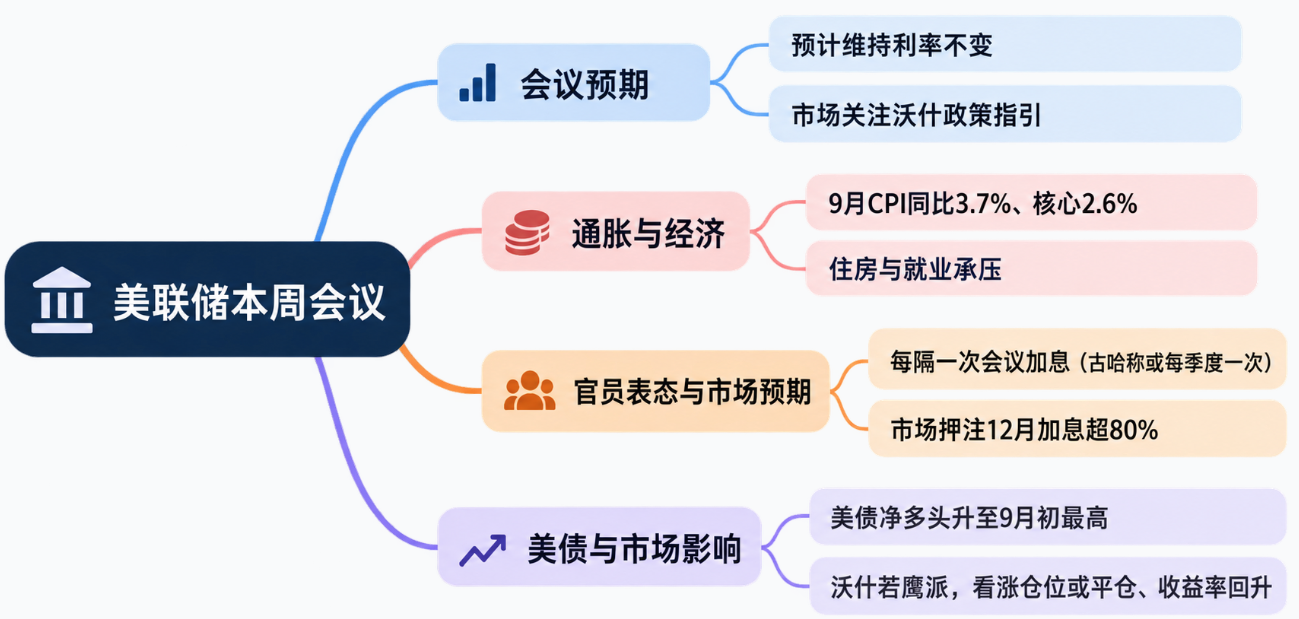
The Federal Open Market Committee (FOMC) will release its decision at 2 a.m. Beijing time on Thursday. Markets broadly expect the Fed to keep the benchmark rate unchanged after it raised rates by 25 basis points in September. However, investors' real focus will be on how policymakers signal the future policy path, especially what signals Fed Chair Kevin Warsh sends.
Brett Ryan, senior U.S. economist at Deutsche Bank, said he will focus on how Warsh describes the future monetary policy path. Warsh has been reluctant to telegraph policy direction in advance, hoping the Fed will reduce its reliance on forward guidance and no longer preview policy moves to the market as frequently as it has since the start of the 21st century.
Ryan wrote in a note to clients that Warsh may suggest recent inflation data further validated the judgment made at the September meeting: over time, the Fed may still need to tighten policy further. However, skipping an October rate hike would also give officials more time to assess changes in the data.
Inflation Heats Up Again, Housing and Labor Markets Under Pressure
Recently released inflation data have not eased price pressures that had already intensified earlier this year.
The Consumer Price Index (CPI) showed U.S. headline inflation rose to 3.7% year over year in September, driven mainly by surging energy prices. Excluding volatile food and energy prices, core CPI rose 2.6% year over year, still above the Fed's 2% inflation target, and increased by 0.3 percentage points from August, indicating that price pressures have not eased across the board.
Meanwhile, mortgage rates above 7% have put further pressure on the U.S. housing market. The labor market has shown a 'low layoffs, low hiring' pattern: layoffs are near their lowest level since the late 1960s, but unemployed workers still find it difficult to secure new jobs.
Against this backdrop, adjustments to monetary policy have become especially complex. Pausing rate hikes can help the Fed assess how much previous tightening has affected the economy and financial conditions; but if inflation remains slow to decline, the Fed may again be forced to raise rates further. In that case, the housing market, consumer lending, and other rate-sensitive sectors of the economy could face greater pressure.
Warsh wants to build a Fed with a more flexible policy stance, reluctant to commit early to a future rate path and preferring to let markets judge the policy direction based on subsequent data. The challenge is that the Fed must demonstrate its determination to control inflation while avoiding locking in the magnitude and pace of future rate hikes too early.
Economists Warn: Policy Execution Risks Rising
Krishna Guha, chief economist and head of central bank strategy at Evercore ISI, believes there is substantial risk of policy mistakes in the current environment.
Guha said in a Monday note that Warsh is alert to market risks and should, in theory, be able to project a calm and steady leadership style, but the Fed faces major challenges in policy execution.
He pointed out that the Fed has not fully explained how it weighs the risks to its dual mandate—maintaining low inflation and achieving full employment—nor has it clearly explained how it assesses the degree of current monetary policy tightening. These information gaps make it harder for markets to judge what the Fed will do next.
Although inflation remains persistently elevated, the U.S. unemployment rate has broadly held steady. At the same time, financial conditions are also changing. The Chicago Fed Financial Conditions Index shows that financial conditions have tightened slightly since the September rate hike, with increased stock market volatility being one factor.
Recent remarks by key officials such as Fed Vice Chair Jefferson and New York Fed President Williams point to one possibility: if inflation pressures persist, the Fed may adopt a pace of hiking at every other meeting. But how many hikes may be needed remains unclear.
Guha believes Warsh's recent remarks at World Bank and International Monetary Fund events in Bangkok are broadly aligned with the mainstream view inside the FOMC. This suggests the Fed may pursue a cautious, orderly tightening pace, with one rate hike per quarter as a possible baseline path, adjusting its judgment based on data rather than ruling out any rate level in advance.
He added that if inflation data continue to disappoint, or if economic growth momentum fails to cool, the Fed may raise rates further.
Markets Bet on a December Rate Hike as Economists Remain Divided
According to CME's FedWatch tool, federal funds futures indicate that the market has priced in roughly a 10% probability of a Fed rate hike this week, while the probability of a December hike has exceeded 80%. The market also sees some possibility of another hike in March 2027; by the end of 2027, the probability of the Fed raising rates once more is about 50%.
However, economists remain clearly divided over whether the Fed should continue tightening policy.
Citigroup economists believe inflation data may moderate in the coming months, giving the Fed grounds to hold rates steady and even creating conditions for rate cuts to begin next year. Citigroup, however, still forecasts that the Fed will raise rates in December this year.
Allianz Group Chief Economic Advisor Mohamed El-Erian expects the Fed will ultimately raise rates, but he believes doing so would be a mistake because higher borrowing costs could hurt vulnerable areas such as the housing market and worsen economic inequality.
El-Erian said on a CNBC program on Monday that the market's view that the Fed will not act this time is correct, but Warsh will have to use fairly hawkish language to explain the decision because inflation data have generally come in above expectations.
He believes that addressing inflation concerns and rising U.S. Treasury yields should rely on fiscal restraint rather than monetary tightening. If the Fed ultimately chooses to tighten policy further, the sectors hit may not be limited to technology. El-Erian noted that the impact on the technology sector may be relatively limited, while areas such as housing, auto loans, and personal consumer loans could face greater pressure.
For the Fed, the challenge at this meeting is not only whether to raise rates, but also how to explain the rationale for holding back while preserving necessary policy space. If Warsh sends a stronger inflation signal, expectations for a December hike may strengthen further; if he emphasizes patience and watching the data, it may temper recent tightening bets. In any case, the trajectory of inflation will continue to determine the policy path.
U.S. Treasury Long Bets Heat Up; If Warsh Sends a Hawkish Signal, Lower-Yield Trades Face Reversal
If the Fed takes a tougher stance at this week's policy meeting, the bullish positioning recently accumulated in the U.S. Treasury market could face a sharp reversal.
If Warsh sends a hawkish signal on key issues such as inflation, the market may reassess how high the Fed will ultimately raise rates, potentially triggering a painful wave of liquidations. Previously, some traders had built long positions betting that safe-haven flows would continue into U.S. Treasuries, positioning for lower yields and higher bond prices.
Citigroup strategist David Bieber said that ahead of the FOMC meeting, the clearest change in the market was investors shifting to tactical longs in both U.S. Treasury and European bond markets. He noted that traders are chasing the bond rally by building bullish positions, even though the market remains net short on an overall structural basis.
CME open interest data show that over the past week, traders have been reducing U.S. Treasury short positions while betting that the recent rally can extend. Factors behind the rally include concerns about the sustainability of the AI trade and pressure in the French Treasury market.
Last Friday, U.S. Treasury futures saw large-scale position unwinds, especially in contracts tied to the 10-year Treasury. The previous day, the Treasury market had just posted its best session in more than two years, while 10-year Treasury-related contracts saw a large increase in new risk exposure, with trading characteristics consistent with short covering.
JPMorgan's weekly survey also showed that the market's net long positioning has risen to the highest level since early September.
Columbia Threadneedle portfolio manager Ed Al-Hussainy said that the key factor determining whether the market can continue to maintain its current pricing is the Fed's policy guidance.
This means that even if the meeting ultimately does not result in a rate hike, Warsh's comments on future policy could still change the market's trading logic. If the Fed clearly signals that it remains prepared to tighten policy further, traders may need to reassess their bond long positions, and the bullish trades built recently could face the risk of forced liquidation.
Meanwhile, options market traders are actively hedging portfolio risk against scenarios of further declines in yields and continued rises in bond prices. This demand has pushed up the cost of related hedging options, with costs rising last week to their highest level since March.
Many traders are protecting themselves by buying call options with different structures, and some strategies are betting that the 10-year U.S. Treasury yield will fall further to about 4.6% in the coming weeks.
The call/put skew in the options market has also changed markedly, with market pricing shifting strongly toward call options. In other words, traders are now willing to pay a higher premium to hedge against further declines in yields than against the risk of rising yields.
This positioning shift reflects continued expectations for a rebound in Treasuries, but it also means trades are more vulnerable to policy signals. If Warsh emphasizes persistent inflation pressures and the need for the Federal Reserve to raise rates further, investors may quickly exit bullish positions, putting pressure on bond prices and lifting yields; conversely, if he does not further reinforce tightening expectations, recent long trades may continue to be supported.
The Federal Reserve meeting this week therefore concerns not only whether short-term rates will be adjusted, but also could become a key inflection point for repricing positions in the Treasury market. The real risk is that bullish bets have already increased markedly; once policy guidance diverges from market expectations, the trading flows that originally pushed bonds higher could turn into pressure to accelerate position unwinds.
Source: TechFlow